

You’ve been building AI capital for six months. None of it belongs to you.
Not the voice calibration that took weeks of prompts to get right. Not the domain context your AI absorbed from your real projects. Not the communication patterns it learned: the ones that make your outputs sound like you wrote them.
Nate’s Newsletter put a name to it: AI working intelligence. The AI that knows your voice, your projects, your pushback patterns, the way you need complexity framed for different stakeholders. Six months of serious work builds something qualitatively different from a fresh account.
Last month my receipt pipeline processed seven Lowe’s purchases. It extracted vendor, amount, date and line items from every one of them at full confidence. No manual review flagged, nothing ambiguous.
It recorded which property the money was spent on for zero of them.
Not because extraction failed. The field is hardcoded to null and deferred to whoever reviews the queue later. Every receipt carries the same store number, so there is nothing to infer from. And the rules table that is supposed to learn my vendors has been live four months and contains no rules at all.
Four months, a working engine, and not one rule in it. Writing rules is a task with no forcing function. It never blocks anything, so it never happens.
So I tried to fill it in myself, a month later. I got six of seven right. For the seventh I confidently named a property that had nothing to do with it. One that isn’t even in the system.
I had not forgotten. I had lost the ability to know something was missing.
I had already fixed this. When we added photo receipts, we put a property selector on the capture form, because the person standing at the register is the only one who knows. That fix landed on the channel I happened to be testing. The channel that runs by itself never got it, and that is the one processing everything.
Mine was one empty field. Most operators don’t meet their version of it until they switch tools.
What AI working intelligence actually is
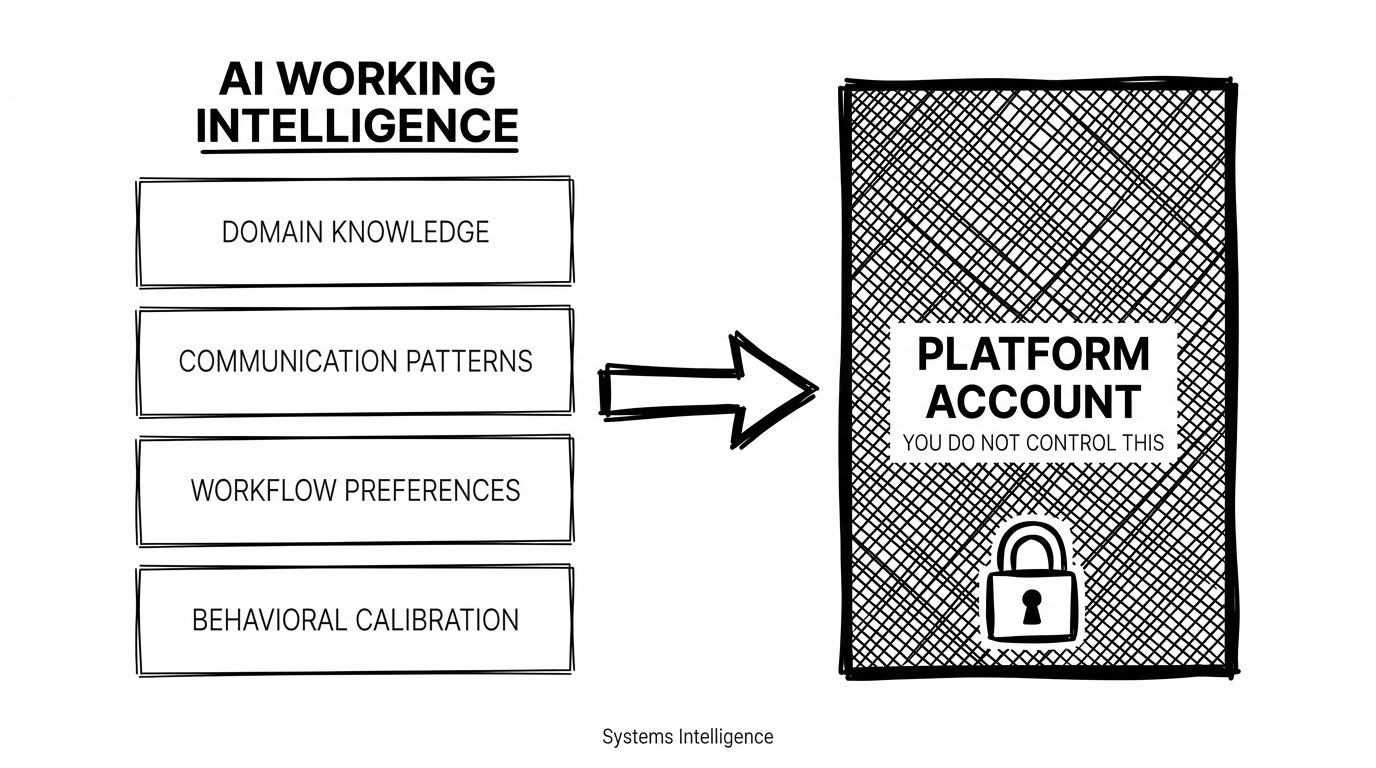
Here’s what makes this different from losing a file. AI working intelligence has four components: domain knowledge absorbed from your field, communication patterns tuned to your voice and register, workflow preferences built up over months of use, and behavioral calibration. Professional capital that compounds with use.
Almost all of it is distributed across tools you can’t merge, stored in accounts you don’t control, and owned by companies whose terms of service are clear about what belongs to them.
Where it goes
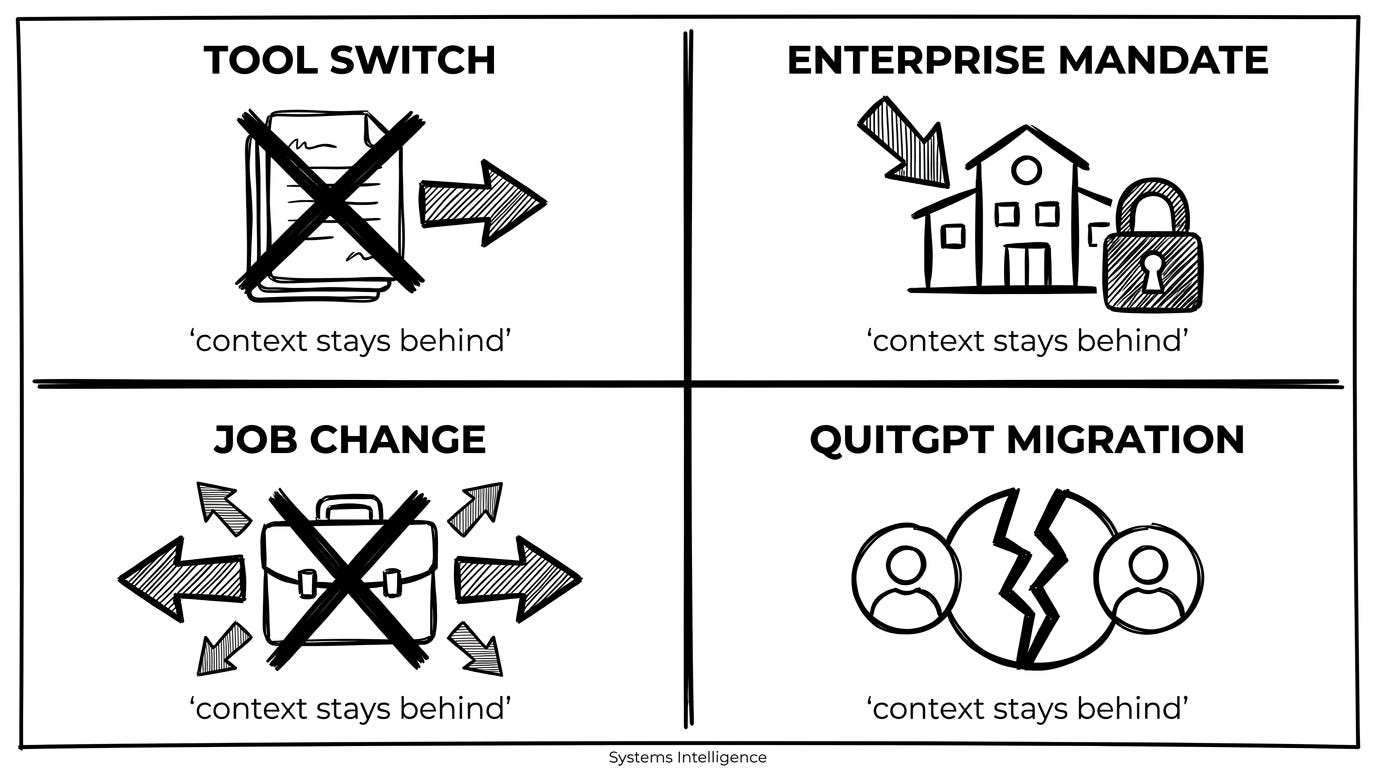
There are four moments when AI working intelligence evaporates. None of them are edge cases.
The first is a tool switch. You move to a different platform because of a price change, a feature gap, or a directive from above. Every calibration, every trained pattern, every context stays behind.
The second is an enterprise mandate. IT rolls out an AI policy. Your account is disconnected. You start from zero inside a new environment with none of the context you built.
The third catches people off guard. You move to a new role. You can’t take your prompts. You definitely can’t take your account context. Six months of professional capital stays at the company you left.
The fourth is the subtlest, and Nate’s Newsletter named it: QuitGPT migration. Your company procures the enterprise tier. Your personal account stays personal, in a different data silo. The accumulated intelligence doesn’t transfer.
This isn’t a design flaw. It’s a deliberate structure. None of the major platforms have built the layer that would let your accumulated intelligence leave. The capital is real. The ownership isn’t yours.
The architecture that changes this
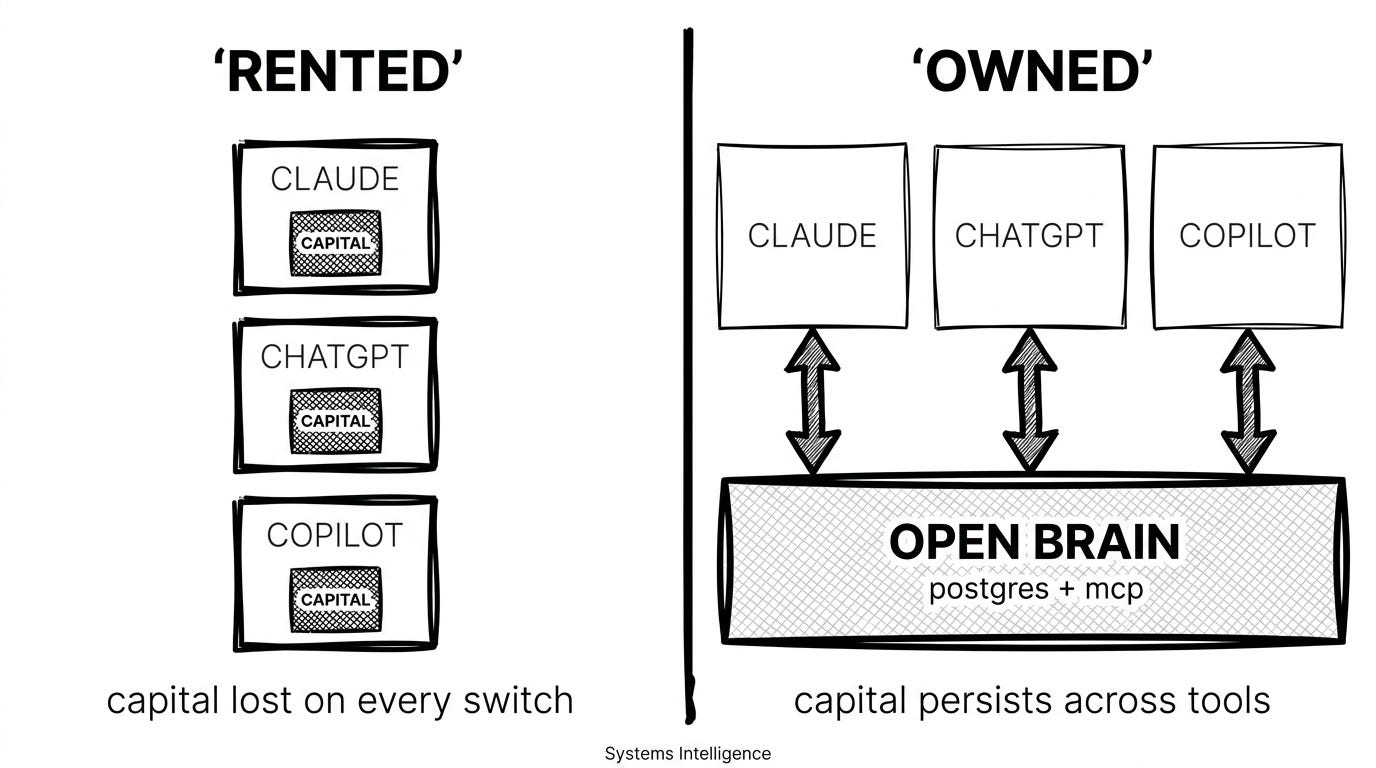
The fix has a name. Nate calls it the Open Brain: a Postgres database, connected via MCP, that creates a portable context bundle. Domain knowledge, communication patterns, workflow preferences, calibration. All stored in a layer you control, not in an account you rent.
When the tool changes, the context doesn’t. The AI you connect to tomorrow inherits the capital you built today.
This is what the hub’s memory layer is built to do. The file-based store running now is the starting version: what a portable context layer looks like before it has a database underneath it. The Supabase layer that makes it persistent, queryable, and tool-agnostic is in design and testing on our own infrastructure, with a set of enhancements still ahead of it. It is deliberately not in production.
That sequencing is part of the argument, not a caveat to it. The layer that holds everything your organization knows is the last thing you should ship on someone else’s schedule.
The infrastructure isn’t exotic. Postgres + MCP is buildable with available tools. What’s missing for most operators isn’t the technology. It’s the architectural decision to treat AI working intelligence as capital worth owning, not as a convenience that lives in a platform you tolerate.
The AI tools available to you will keep improving. The intelligence you build with them compounds the whole time.
The question is whether that compounding belongs to you or to the platforms it runs on.
For most operators right now, the answer is the platforms. Not because they chose that. Because nobody made the architectural decision to own the layer where the capital lives.
Which of the four layers costs you the most when you switch tools or start a fresh session: domain knowledge, communication patterns, workflow preferences, or behavioral calibration? Reply with one sentence. I’m mapping where operators lose the most ground.
Next issue: the Karpathy model for AI knowledge that compounds instead of resets, and what it takes to build in practice.
Last week on Systems Intelligence
Issue 4: The Composable Stack Has No Hub covered why the tools compose but the knowledge doesn’t, and what a hub does that a spoke can’t. This issue asks the harder version of the same question: the capital accumulating in that hub, whose is it?
Systems Intelligence covers AI architecture for the Pragmatic Operator: builders who need AI that works, not AI that demos. If this resonated, forward it to someone whose AI context lives in an account they don’t control. If you’re new, start with Issue 1.
— Jerry Shields · systemsintel.dev